Two chroniclers of a way of life
Why did he take so many photographs of a single subject? That is the question raised by the series of pictures that Karl Heinz Hargesheimer, who called himself Chargesheimer, took in Cologne’s Südstadt on 8 April 1956. When Chargesheimer had a commission to carry out, he usually went to the spot and contented himself with a single exposure. Today’s users of digital cameras may find that hard to imagine. With Chargesheimer’s way of working, sometimes seven of the eight exposures on a strip of film made it into the finished book. His confidence in his own abilities must have been boundless.
These and many other facts would have remained undiscovered without the extensive research of Eusebius Wirdeier. While working on his “Fotogeschichten Sülz und Klettenberg 1955–1985”, he came across unknown photographs by Chargesheimer. Chargesheimer had photographed in the Südstadt more often than previously assumed. For months Wirdeier sifted through pictures from the holdings of the Rheinisches Bildarchiv, which comprise 40,000 negatives. This is also where the archive of shoeboxes is kept in which Chargesheimer stored his work. Such relics – as well as the monstrous-looking Linhof Super Technika III 6 × 9, the camera he preferred to work with – can now be seen in the exhibition Chargesheimer / Kölner Südstadt / Eusebius Wirdeier at the Forum für Fotografie Köln.
Striking was the body of work from 8 April 1956, White Sunday, one week after Easter, when Catholic children receive their First Holy Communion. A day of sleet. How cold it must have been is revealed by the look of a freezing girl who had been sent with a little milk can to the Niedeckens’ grocery shop by the Severinstorburg to fetch loose milk. A little later, families hurry with the first communicants through streets still badly scarred by the war. Their destination is St. Severin, where Chargesheimer was able to photograph the 90 children in front of the altar from the gallery. As an interested observer of social life on the street, he does not miss the moments when the families stop for a chat on the forecourt of the church after Mass. Why did he put together a complete photo reportage of this day when the first editorial meeting for the book Cologne intime only took place two months later and the pictures ultimately remained unpublished? The riddle remains unsolved. For this exhibition, the Rheinisches Bildarchiv printed the negatives on baryta paper, and they now have an extraordinary plasticity. Chargesheimer’s deep interest in the lives of the people in front of his camera becomes evident in the pictures of the young women heading home after their shift at the Stollwerck chocolate factory. Or of the greengrocer sweeping the street in front of his shop, of the grandmother standing on the doorstep in her old slippers. But he also does not miss the policeman in the same pose, whose spotless boots evoke uneasy associations.
The rediscovered picture
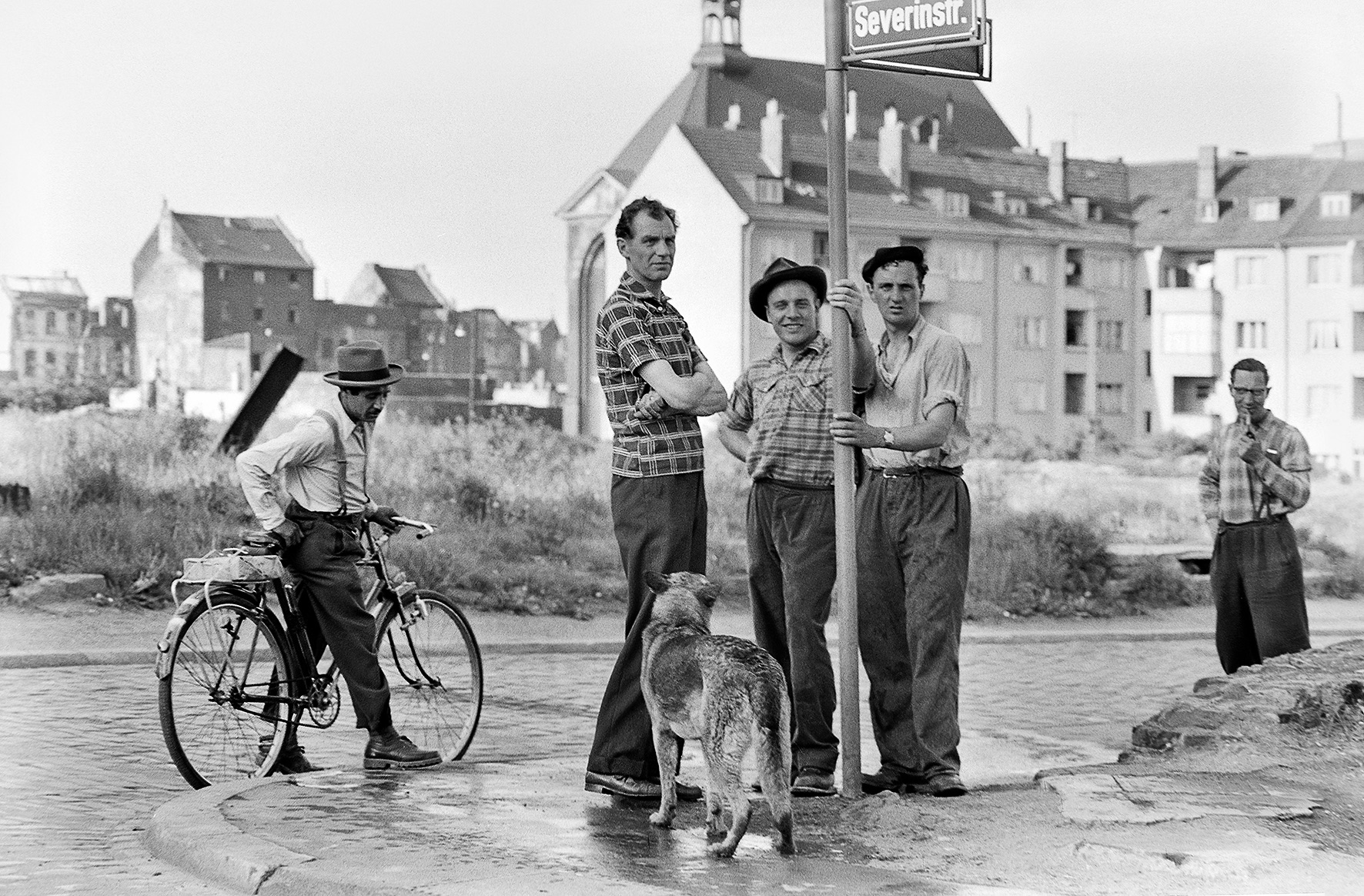
Chargesheimer was a street photographer who sought direct contact with people and even spoke to them before pressing the shutter release – a practice rarely found even among American photographers of the time. That is presumably how he approached, joking, the three men on the corner of Landsbergstraße and Severinstraße: a crossroads consisting of no more than two street signs, behind which, even ten years after the war, the traces of wild destruction could still be seen. The picture achieved dubious fame because the then head of the tourist office, Hans Schmitt-Rost, placed the men close to petty thieves in the caption of the later publication Cologne intime – something the three men successfully fought in court. Chargesheimer cropped the picture so that, besides the three, only the man on the bicycle at the left, apparently in dialogue with the dog, could be seen. Wirdeier, however, found the original, composed like a panel painting. In it a further man appears at the right edge, calmly smoking his pipe as he watches the scene. With him as an observer in the picture, the photographer and the act of photographing themselves become the subject.
In the months before and after the pandemic, Eusebius Wirdeier followed the routes Chargesheimer had taken through the Südstadt and sought out his lines of sight. Life in these streets today is marked by much more movement. The women in the picture are looking at their phones. Faced with the slogan Make Kölsch Not War on a cyclist’s bag, Wirdeier asks himself: “If we were in the post-war period back then, where are we today?”
Whereas Chargesheimer himself became part of the action through his interaction with the people in front of his camera, Wirdeier adopts the stance of an observer. Eusebius Wirdeier, now 75, has been familiar with Chargesheimer’s work since childhood. After all, the legendary photo book Cologne intime stood within the children’s reach on the shelf of his parents’ home in Cologne-Weidenpesch.
A committed photographer
Patient observation is one of Wirdeier’s special talents. In the process, time becomes his ally. In the early 1990s he was one of the first photographers to document the protests in the lignite mining area, which at the time were still local in character, with no demonstrators travelling in from elsewhere. In his documentation of a hardware shop in Cologne-Sülz, entitled “Die Wunderkammer der Agnes Bosen”, he measured the depth of time. How subversive persistent observation can be, he proved in his long-term study, lasting more than ten years, of the so-called “Kölner Loch”, the hole that opened up at Neumarkt after the Kunsthalle was demolished. A politics oblivious to culture had robbed Cologne of one of its most important cultural achievements. In an era with little memory, it is comforting that someone like Eusebius Wirdeier documents the city’s catastrophes, which later also included the collapse of the City Archive – Wirdeier captured the corresponding hole in pictures as well. Nevertheless, Eusebius Wirdeier is no misanthrope. With his camera he accompanied, for example, the restoration work on the Romanesque church of St. Severin, thereby opening up new ways of understanding the building. A further photo book is in preparation, documenting the five-year renovation of St. Pantaleon.
Eusebius Wirdeier is a pictorial chronicler who shows viewers the results of political decisions and their consequences for the body of the city. For him it is not the single picture meant to explain everything that counts. Photography wages a battle over the significance of the moment, which threatens to be consigned to oblivion by the ongoing course of events – a battle against time. Wirdeier plays out another potential of photography by managing to win time over to his side. His long-term observations are based on a commitment that he does not, however, put on display. It only reveals itself in reading the pictures. Thus in his photographs of Cologne’s Südstadt one can sense the particular vitality and a certain well-being that the people in these pictures display. Pictures that already seem historical again. The world seems to be turning ever faster – good that someone is there to hold on to it for us in pictures.