Following the exhibition “Die zweite Heimat” (The Second Homeland), shown until 7 January 2018 at the Haus der Photographie of the Deichtorhallen Hamburg, the Forum für Fotografie presents a selection of photographs from this cycle in Cologne. Peter Bialobrzeski was already a guest at the Forum für Fotografie in 2012 with his photographic trilogy “Case Study Homes”, “Informal Arrangements” and “!Nail Houses?”, brought together under the exhibition title “Habitat”. All three series were conceived as investigations both of formal aesthetics and of social analysis. Bialobrzeski’s view at the time of the dwellings built in the precarious living spaces of Manila, Shanghai and Cape Town could also be understood as a kind of engagement with the concepts of home and homeland.
From 2002, by contrast, Bialobrzeski developed an explicit engagement with the theme of homeland and gathered the resulting photographs in the photobook “Heimat” published in 2005. To better understand his aesthetic approach to homeland at that time, as well as the pictorial forms of his renewed approach in “Die zweite Heimat”, it is worth reading his remarks from 2005:
“At the same time a German photography developed that recorded garage doors, cardboard boxes and pale, spotty young managers at a supposedly critical distance. These pictures claimed to be documentary, to objectify. Their advocates were suspicious of any emotionality; any association with beauty seemed a betrayal of the supposedly so new German photography. Of course the ‘New German Photography’ is nothing more than an aesthetic pattern, whose pioneers rightly attacked traditional pictorial concepts with their pictures. Later, beneath my studio window in Hamburg, pasty young people hung on billboards advertising Deutsche Telekom. That became the first trigger for the idea of photographing something ‘beautifully’ that was not supposed to be beautiful. The German landscape. The second trigger was my appointment at the HfK Bremen and the associated need to spend at least eight months a year in Germany. I wanted to clarify my relationship to my image of Germany, a country that has shaped me emotionally and culturally – in other words, homeland.
My photographs are projection surfaces of post-postmodern people for the longing for nature. However, silence no longer belongs to one alone. ‘Homeland’ means having roots, not necessarily being rooted. The earth from which they come determines the code, but not the substance. So ‘Heimat’ is not a book about Germany as homeland either, but sketches a picture that, beyond a dark past, reunification and ‘German Disease’, fixes a personal piece of pictorial and cultural history.”
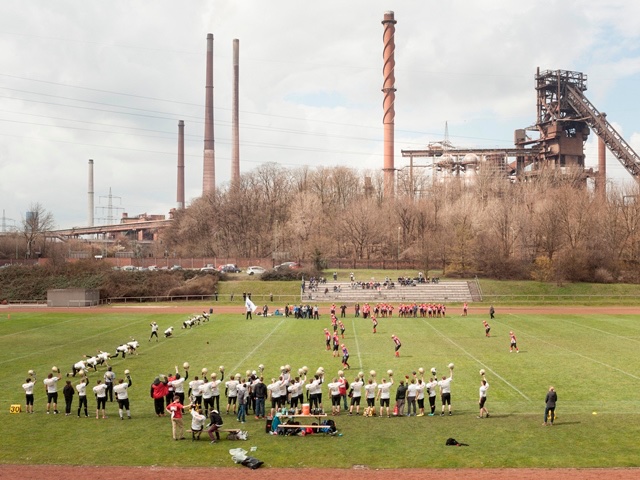
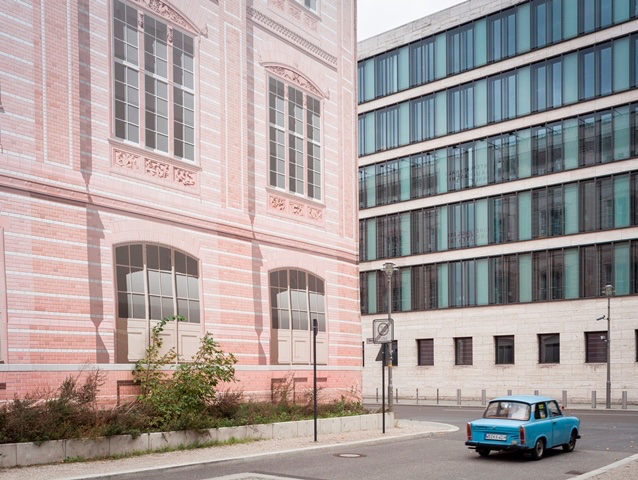
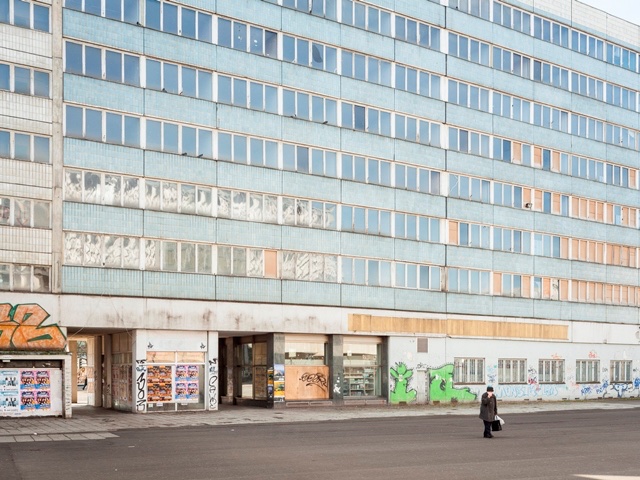
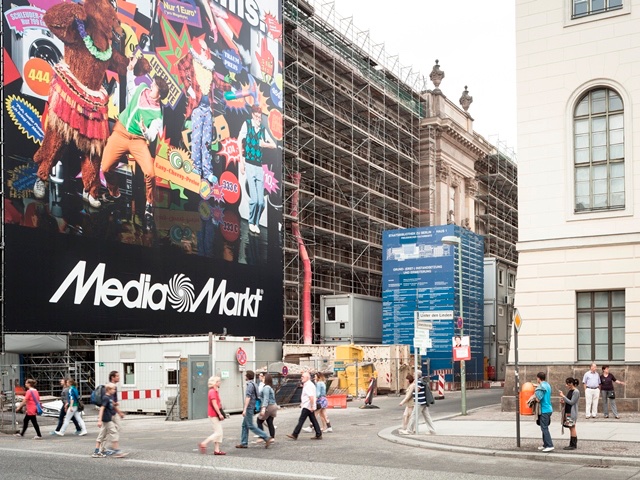
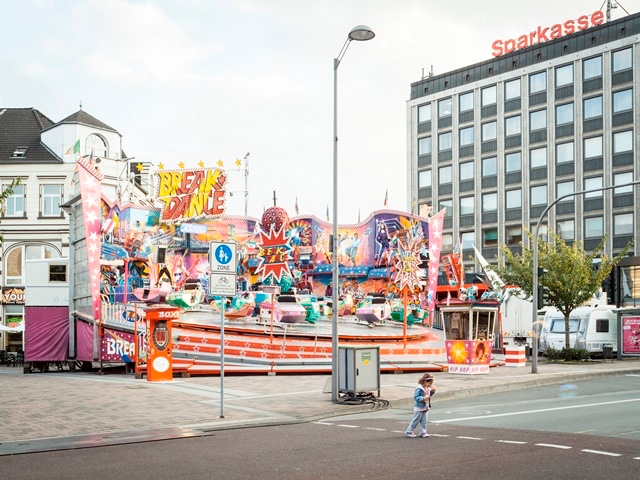
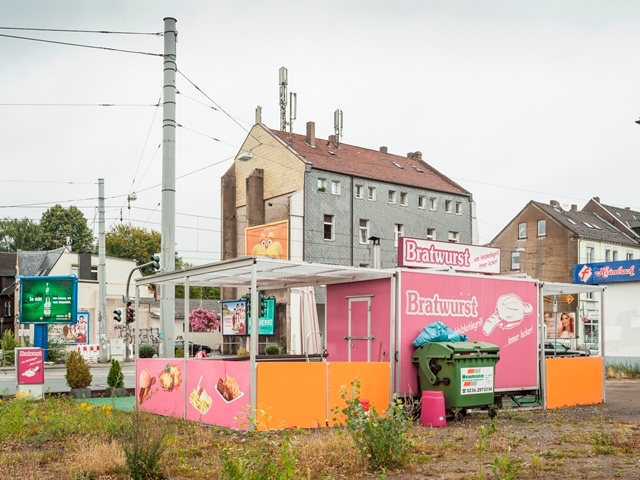
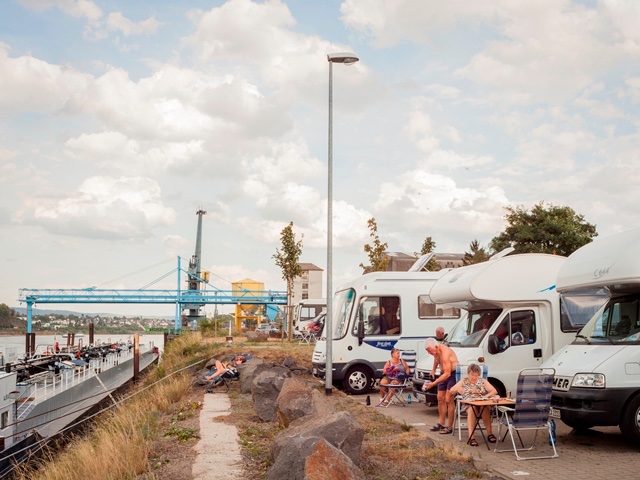
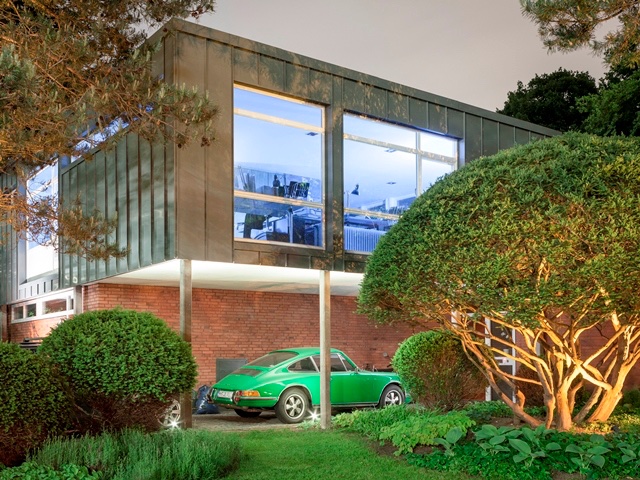
And how does one deal today with the overused concept of homeland, in times of globalisation and refugee movements, of political instrumentalisation? In times when homeland not only defines identity but also excludes others? To find out, Peter Bialobrzeski set out again between 2011 and 2016 and brought back sober, at times sobering observations of the German homeland from Andernach, Berlin, Bottrop, Eisenhüttenstadt, Frankfurt am Main, Hagen, Hamburg, Meißen, Offenbach, Wolfsburg and many other places. Now he takes us into cul-de-sacs, backyards and deserted crossroads, and in front of the façades of department stores, sausage stands, building sites, bus stops, garage doors and driveways – places that do not always invite one to linger. In calm, undramatic pictures, the status quo of the German urban landscape is laid before our eyes.
In the low-contrast lighting characteristic of Bialobrzeski, this focus on the unspectacular and everyday sometimes seems relentless. The architectural incongruities, presented with dissecting sharpness and familiar to us all, often convey an impression of disconnection and social isolation. When the mostly absent people do appear somewhere in the picture, they seem out of place and accentuate the prevailing impression of bleakness, dreariness and loneliness. At best they appear uninvolved, at a loss or as if immunised against their surroundings. Architecture and the individual figure thus form the main components of a field of tension. The question of identity and homeland that arises almost by itself when looking at the pictures is directed at the degree of resignation with which people have settled into this habitat.
The expansiveness of romantic landscape scenes, and indeed any hint of mood, seems to have been driven out of the current image of homeland and to have given way to a general disillusionment. It is also evident, however, that even without romanticism and easy beauty, Bialobrzeski remains true to his premise of photography as picture and to the difference between looking at reality and at art. Bialobrzeski’s distanced, neutral vantage point and his cool, precise compositions help him to transform the supposedly ugly into structurally and chromatically complex artefacts of strange beauty. Moreover, Bialobrzeski’s photographs possess great presence and intensity, above all through his strict documentary approach, his rigorous conception of the image and the clarity of his compositions.
“I want to be everyday and authentic,” says Peter Bialobrzeski. Henning Sussebach explains this authenticity: “On his travels he had set the satnav to ‘avoid motorways’. Searched for motifs in often overlooked in-between worlds, backyards, cul-de-sacs. And corrected himself right at the start of his work on the second homeland. At first he had destinations in mind, German places. Shareholder meetings. Demonstrations. The Hanover Fair. But then wouldn’t a football stadium have had to be included too? A party conference? A beer garden? Cologne’s Domplatte? It would have become a matter of filling moulds, proportional coverage photography. Moreover, every predetermined destination would inevitably have been linked to an expectation, if not a judgement, that obstructs the free gaze.”
Peter Bialobrzeski has sketched an image of homeland that is neither beautiful nor ugly and that, because of its claim to authenticity, guarantees that we can all find ourselves in it.
Text: Thomas Appel