
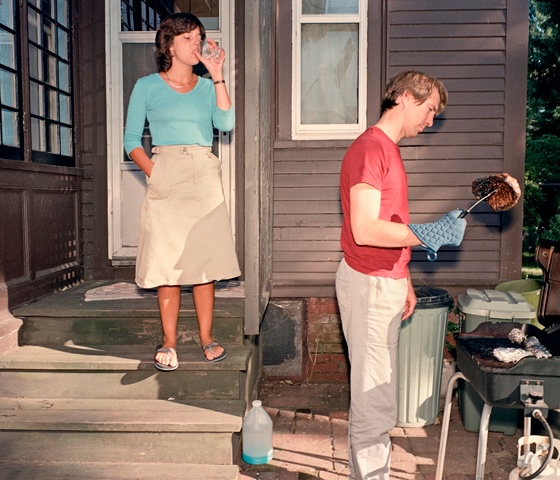
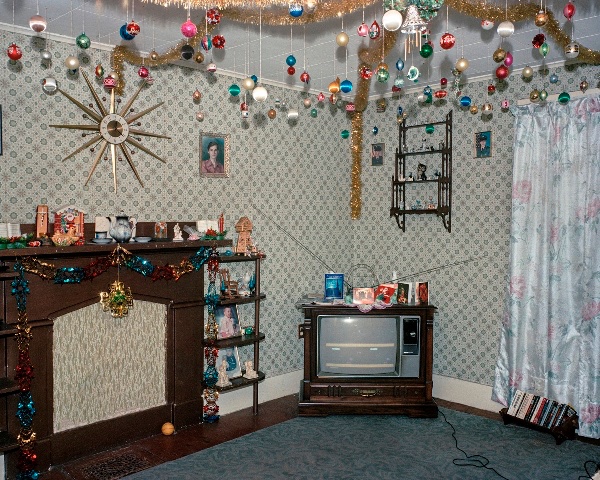
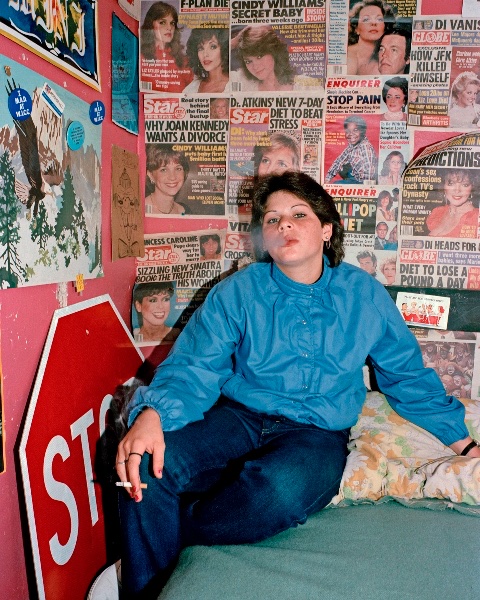
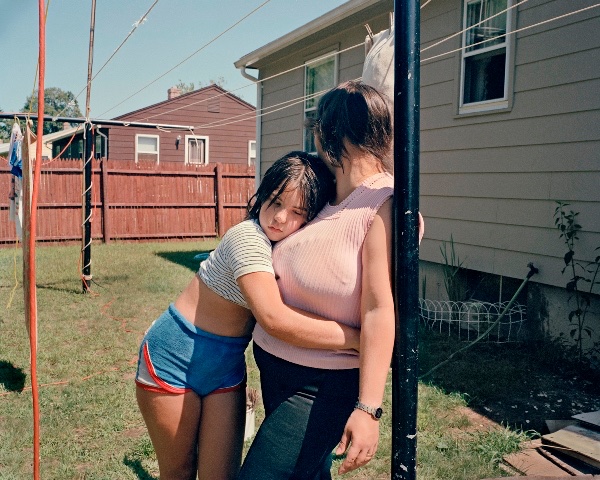
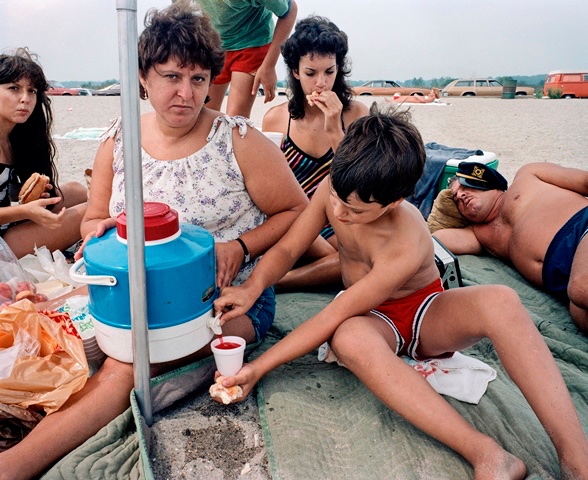
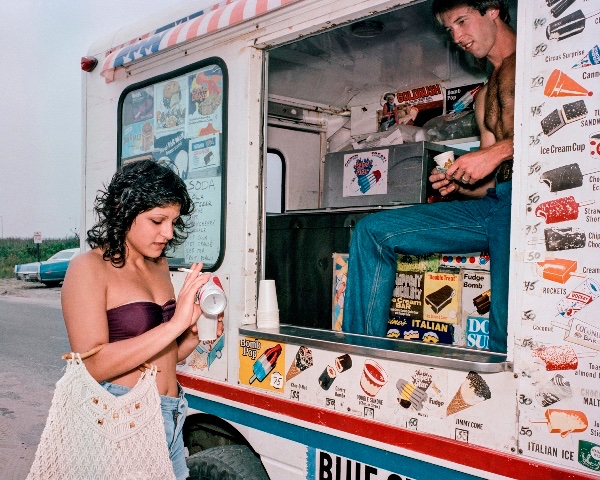
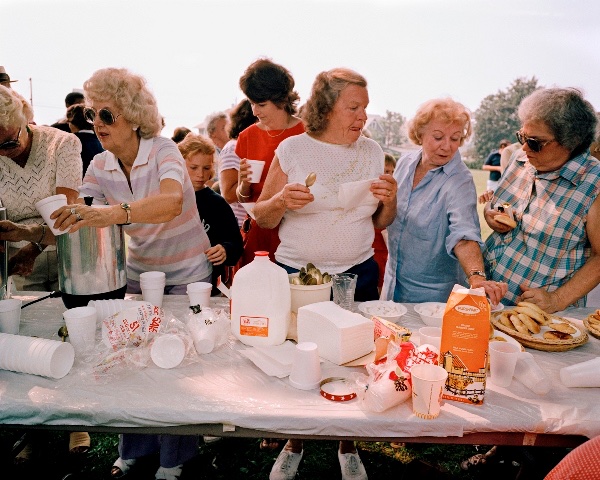
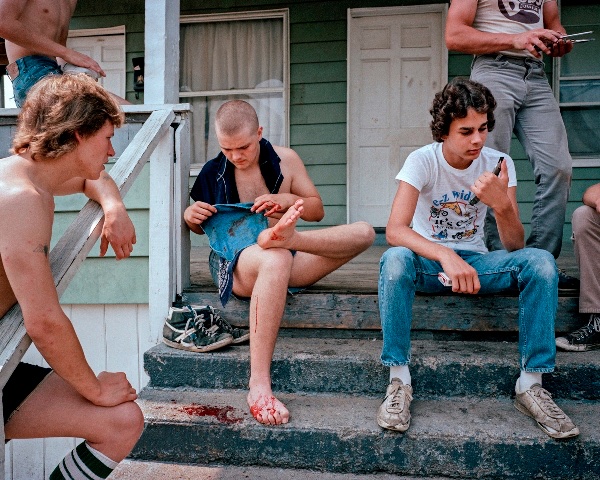


An important body of work in the history of American photography is being rediscovered. The Forum für Fotografie is showing works by the photographer Mary Frey for the first time in Europe. They take us to a small town in western Massachusetts, into the America of the 1970s and 1980s. At first glance, the pictures reveal an artistic dialogue with the great pioneers of American photography, which can be clearly demonstrated.
In 1991 Peter Galassi curated an exhibition at MoMA in New York entitled “Pleasures and Terrors of Domestic Comfort”. The catalogue of the MoMA exhibition reads today like a compendium of “New American Photography”. All the participating photographers are of high artistic standing and renown: Philip-Lorca diCorcia, William Eggleston, Gregory Crewdson, Cindy Sherman, Nan Goldin, Tina Barney, Joel Sternfeld, Nicholas Nixon, Lee Friedlander, Stephen Shore, Larry Sultan, Robert Adams, Larry Fink, Sally Mann and … Mary Frey.
As a university teacher at the Hartford Art School, Mary Frey shaped several generations of students between 1979 and 2015. Although after this MoMA exhibition she repeatedly took part in solo and group exhibitions in the USA, after the birth of her child she gave up a public presence on the art market in favour of her family and her teaching. Only after she stopped teaching in 2015 did a new interest arise in putting her work up for discussion once more. At a workshop of the Hartford Art School (Connecticut) in Berlin she met the publisher Hannes Wanderer of Peperoni Books. The Forum für Fotografie Köln owes its contact with Mary Frey to Hannes Wanderer. In 2017 Peperoni Books published “Reading Raymond Carver” with Mary Frey’s black-and-white photographs from 1979 to 1983, originally made under the working title “Domestic Rituals”. The book was a success; soon after publication it was shortlisted for the Paris Photo “First Photobook 2017” award and went into a second edition. In September 2018, in time for the opening of the exhibition, Peperoni Books published Mary Frey’s second book under the same title, “Real Life Dramas”.
In its exhibition from 8 September to 27 October 2018, the Forum für Fotografie presents Mary Frey’s bodies of work “Domestic Rituals” and “Real Life Dramas”.
Frey’s artistic intention is to question the process by which photographic documents come into being. What she seems to depict spontaneously is in truth always the product of careful conceptual staging. In her own words, Mary Frey’s intention is “to question the nature of photographic truth and to use the iconography of middle-class mores to comment on social values and systems” (see also Anna Gripp’s excellent text “Die echten Lebensdramen der Mary Frey”, Photonews 09/18). In both bodies of work, shown for the first time in Europe, the artist engages conceptually with the subject of the family portrait, presenting members of her own family as well as friends and acquaintances from the neighbourhood and surrounding area going about everyday activities and gatherings. The fascination of these harmless everyday scenes lies above all in the fidelity of detail and in the liveliness and intimate atmosphere of the action. The prosaic sobriety of the scenes gives the viewer the feeling of taking part directly. The casualness and family familiarity that speak from the pictures reduce the distance to the viewer and make the scenarios seem plausible without question.
Only a second, attentive look at Mary Frey’s pictures confirms that the perfection of composition and lighting and the virtuosity of chromatic harmonies can hardly be the results of a snapshot realism achieved in spontaneous action, but that her artistic creativity is masterfully expressed in a pictorial direction conceived down to the smallest detail. Spontaneity is produced artificially and is the result of a carefully prepared catalogue of scenes that, using a large-format camera, tripod and the diffused light of single-use flashbulbs, stages the actions, gestures and characters Frey considers significant as “prototypes”. In keeping with her premise that “a photograph shows us what we know, yet contains its own fiction”, Frey subjects the photographic image to a fundamental questioning of the conditions of meaning and truth inherent in photography.
Frey pays particular attention to how our individual self-image and social value system are shaped by cultures of memory and the contemporary context. In this sense she repeatedly quotes pop-cultural influences in her work. Mary Frey is openly influenced by the ubiquity of sitcoms and soap operas on television, of pulp novels and of magazines such as Look, Life and Good Housekeeping. She lets the situations found there flow into her stagings as a quasi style-forming element. This applies above all to her black-and-white photographs, which capture the atmosphere and dynamics of the American middle-class family of the 1970s and 1980s. In the later colour photographs of “Real Life Dramas”, Mary Frey goes a step further, counteracting her works with brief text excerpts from pop-cultural contexts that charge the banality of the everyday scenes with artificial drama.
The original unity of meaning of a documentary picture, which soon turns out to be staged, is thus finally reduced to absurdity in a further step of ironic refraction and paradoxical confusion. Frey reveals and problematises an unbridgeable gulf between the photographic image and the inner psychological reality of those portrayed. Yet Frey does not want to bow to the paradox between image and identity. Like an iconologist who looks at and analyses a work of art through historical analysis and as a testimony to overall cultural phenomena, Frey reflects through the artistic process on the pictorial inventory she uses in each case. For the photographer, what can factually be depicted and the deliberately banal are merely the starting point for reflection on the complexity of psychological states and how they can be conveyed. Gail Buckland sums this up in an analysis of the artist’s work and a comparison with Frey’s great role model Diane Arbus:
“Both women wanted to penetrate private places and be privy to intimate moments. Both women crossed accepted boundaries, Arbus by daring to ‘stare’ at those on the fringe of society and enter the private worlds of transvestites, dwarfs and the mentally deranged; Frey by setting her camera up in bedrooms, bathrooms and kitchens of productive, family-oriented middle-class Americans who were doing nothing out of the ordinary. The drama for Arbus was in how people looked. The drama for Frey is how people think and relate.”
(Exhibition catalogue “Mary Frey: Real Life Dramas”, Western Carolina University, Cullowhee, NC 1987)
Biography
Mary Frey completed her studies at the Yale University School of Art in 1979 with a Master of Fine Arts (MFA) and then taught photography at the Hartford Art School until 2015. She has received numerous awards and grants for her work: a Guggenheim Fellowship (1984), two grants from the National Endowment for the Arts (1980 and 1992), and one grant each from the TeFoundation (2004) and the John Anson Kittredge Fund (2010). In the academic year 1994–95 Mary Frey was Harnish Visiting Artist at Smith College, Northampton, MA. In spring 2001 she completed a residency at the Burren College of Art, County Clare, Ireland.
Frey’s work has been widely exhibited and is part of private and public collections, including the Museum of Modern Art, New York, the Museum of Fine Arts, Houston, the Art Institute of Chicago and the International Polaroid Collection. In 2017 the Berlin publisher Peperoni Books published the book “Reading Raymond Carver” with early photographs by Mary Frey. The book was immediately shortlisted by Paris Photo/Aperture Foundation for the best “First Photobook” of 2017.
Mary Frey lives in Massachusetts.