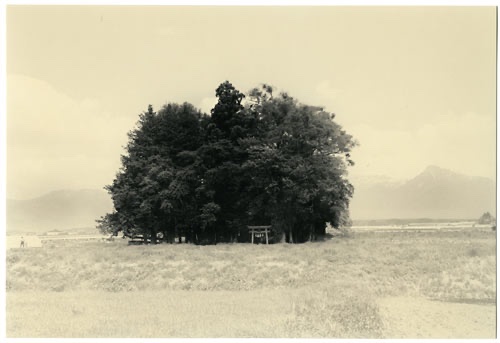
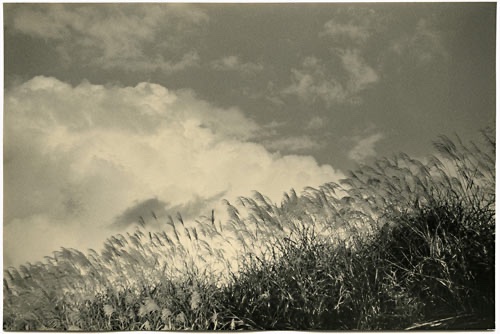
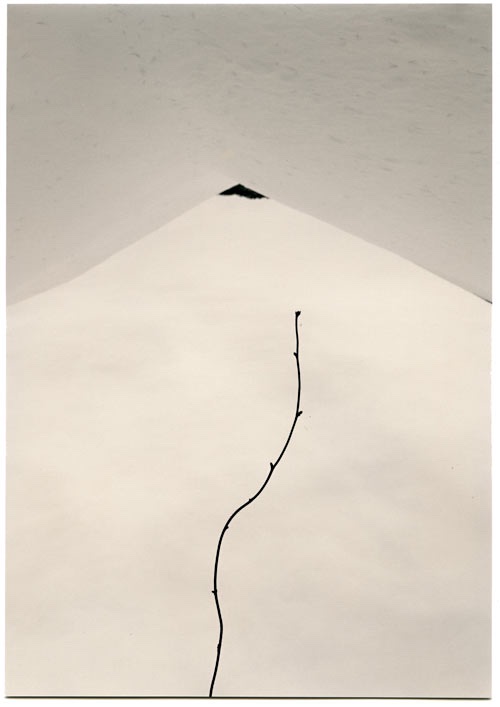
KAWA means river and symbolises human existence in Japanese culture. For the photographer, KAWA manifests itself in nature, where he seeks and finds his subjects. It is less the topographical detail or the physical phenomenon that interests him; Yamamoto is drawn to the mood, the essence of his subject: “I focus my gaze on the clouds, but in fact I am taken up with something else.” And so his pictures carry precisely this indeterminate “other”, which the viewer can hardly escape; the copies of reality have an aura.
Yamamoto’s nature is simple, clear and untouched. Despite their formal clarity, many of his pictures have an ambiguity that achieves what the photographer intends: to give viewers space for their thoughts and dreams, for free association and meditation. In the landscapes of the soul that open up, viewers are meant to feel pleasure or even moments of happiness. To ensure this ambiguity, Yamamoto refrains from giving his photographs titles and assigns them consecutive numbers instead.
Yamamoto Masao compares his work to the Japanese haiku. This three-line, 17-syllable poetry (5/7/5) describes a precisely observed natural object in its unique situation and represents the feelings associated with it without naming them explicitly. While Yamamoto’s nature photographs are on the one hand the expression of his feelings in the face of nature, they also invite viewers to engage with their own mood, which arises when they immerse themselves in the pictures. The subjects of the pictures are only superficially natural landscapes; in reality they are called simplicity, serenity, stillness and happiness.
Yamamoto’s understanding of art is shaped by the Zen teaching of “active passivity”, which serves self-discovery and the development of a deep sensitivity to the universe and the earth. “KAWA is about the world we are in and the world we are going to. Although it seems that we are always connected to everything, there is a rupture between us and those who went before us and will come after us,” says Yamamoto, understanding the rupture as a river dividing the plain, marking the transition from one world to the other. Such ruptures are also expressed in his installations, in which individual pictures come together to form a whole; each print stands on its own and is at the same time an element of the composition.
The photographs are small so that they can be carried around. Some look yellowed or are deliberately worn and crumpled; they are meant to awaken a sense of memory, age and transience. In earlier exhibitions the prints lay loose in a box; viewers were meant to “grasp” them and determine the order of viewing themselves. Yamamoto’s unconventional handling of the medium of photography makes the subtle, mysterious poetry of his works tangible for us.
The Forum für Fotografie shows around 50 individual photographs and photo installations in the exhibition. KAWA is Yamamoto Masao’s third body of work after “A Box of Ku” (The Box of Emptiness) and “Nakazora” (The Space between Heaven and Earth).
Text: Estella Kühmstedt
Yamamoto Masao
Yamamoto Masao was born in Gamagori City, Japan, in 1957. Before turning to photography he studied painting. As a freelance photographer he lives and works in Yamanashi, near Tokyo. While he has long been a recognised artist in the USA, where his works have been shown widely since the 1990s, he is only beginning to be discovered in Germany.