Where the testimonies of European culture are disappearing, Martin Claßen works with his large-format camera. Death and decay are recurring motifs in his work: he has not only descended into the catacombs of Palermo but, since the mid-1980s, has also captured the Baroque churches and villas of southern Italy in the beauty of their decay.
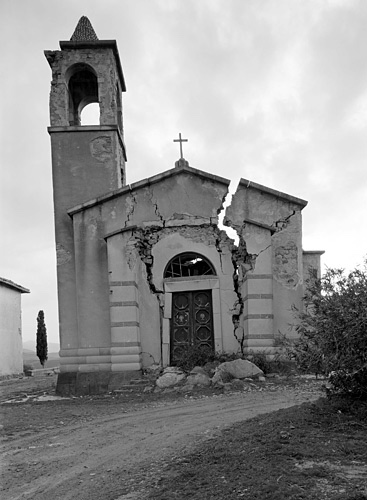
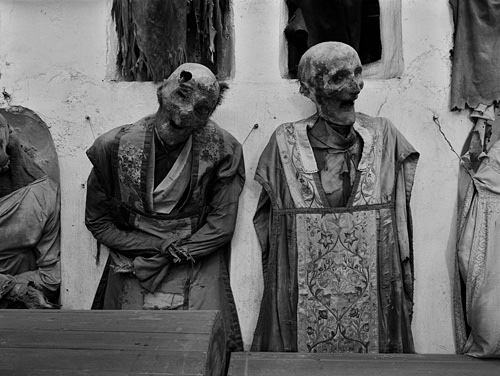
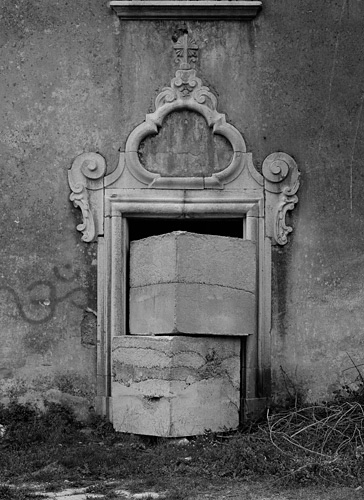
The Forum für Fotografie shows outstanding photographs from Martin Claßen’s various bodies of work, including the series “Verlorene Stätten” (Lost Places) and “Sizilien” (Sicily), pictures of Tuscan and southern Italian church ruins, villas and palazzi, and the series “Catacombe dei Cappuccini, Palermo” and “Cappelle nel Quartiere Spagnolo, Napoli”.
The romantic, elegiac grandeur of these architectural portraits of decaying historic buildings, some staged like theatre sets, is displaced by the sober directness with which destruction and loss of substance are documented. The sublime element of an all too harmless aesthetic of ruins is counteracted, indeed broken through, by the spreading feeling of emptiness, of the desolate and soulless: soulless places as signs of absence, as a manifestation of the “failure of the imaginary”. It is a world of the imaginary, of the religious idea of unity and wholeness, formulated in the symbolic, in the language of its pictorial traditions and its architecture. We see how this imaginary becomes the real again, mute, disenchanted matter.
What is astonishing about Martin Claßen’s pictures, however, is that it is not only destruction that is measured. Something else is documented here, for with the ravaged body of the building, the aura of these spaces has also evaporated; the spiritual space is broken. The religious symbols are now only damaged decoration. Of the transcendence that lets inert matter soar, nothing is to be seen; of the house of God, only dust and bricks remain.
It is the contradiction between history and emptiness, idea and matter, soul and soullessness that links the architectural cycles with the photographic studies of the Capuchin crypts in Palermo. Especially in the pictures of the corpses staged grotesquely as actors, the dramatic struggle of humans to wrest a piece of eternity from death is shown to be absurd. The attempt to keep eternity present results only in the conviction of failure, of loss. How touching, helpless, futile and grotesque the attempts to dress and preserve the dead appear, to want to give them a physical existence beyond death. How fixated we are on the body and its staging.
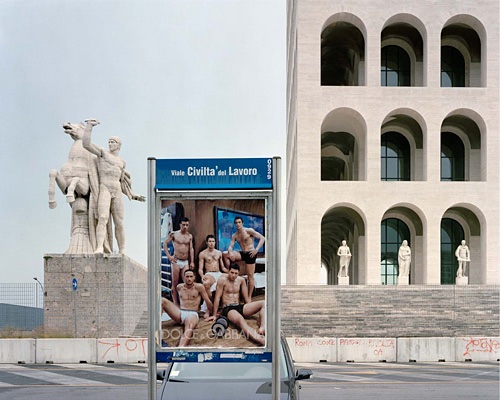
That Claßen’s reflections, developed from historical inventories, can be applied to the immediate present is impressively demonstrated by the 2007 photograph “Palazzo della Civiltà Italiana, Rome, EUR”. Here, in the surreal fusion of wishful images from advertising and political manifesto, a bridge is built to the architectural cycles and the theatricality of the catacombs. Committed to the empty scheme, the “role models” of supposedly opposing worlds united here accuse each other. Both mechanisms seem to want to reduce each other to absurdity. In the constructed space of artificialities only one thing remains: the distorted mask of lost humanity.
Text: Thomas Linden
Martin Claßen
Martin Claßen, born in Cologne in 1959, studied artistic photography at the Kunsthochschule Köln für Grafik und Design. Claßen has taken part in numerous exhibitions, including at the Agfa Historama in the Museum Ludwig Cologne, the Goethe-Institut in Palermo, the Centre Pompidou in Paris, the architects Suter & Suter in Basel and at photokina Cologne 2008 in the Visual Gallery. He is a 2009 fellow of the Villa Massimo, Rome. His publications include “Architektur der 50er Jahre in Köln”, “Dresdner Villenarchitektur”, “Verlorene Stätten – Italienphotographien” and “Sizilien”.
The exhibition was curated by Thomas Linden.