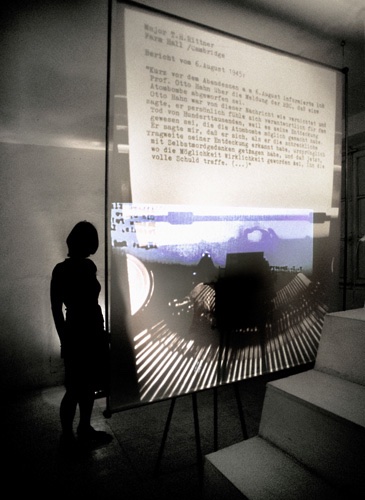
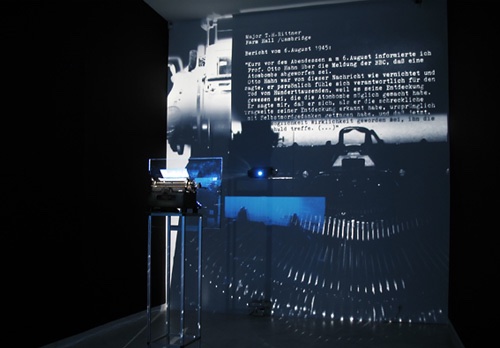
Harald Fuchs is known for his complex themes referring to history and the history of science, which he treats artistically in expansive media installations. The basis for his latest work “Hybrid-Kontroverse”, which Fuchs conceived for the Forum für Fotografie, is a series of historical documents, including Albert Einstein’s letter to US President Franklin D. Roosevelt informing him of the dangers of the possible use of atomic bombs in the near future. This letter is juxtaposed with a letter by Otto Hahn (the document is presented in a film excerpt) in which he looks back (self-)critically on the devastating effects of nuclear weapons.
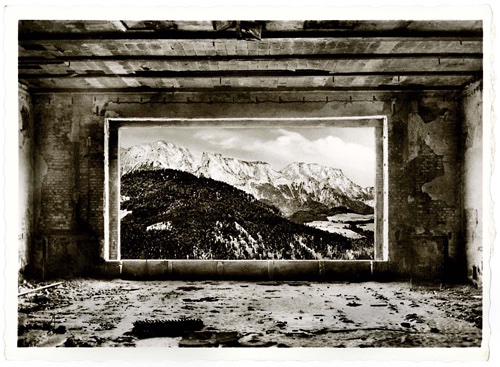
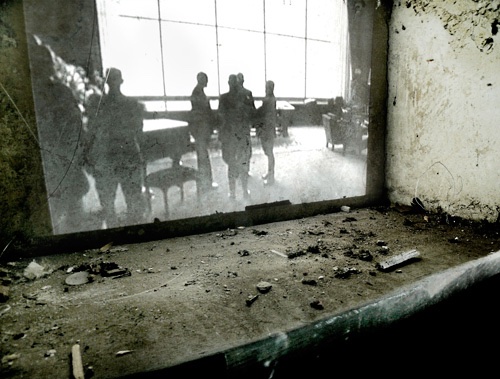
Further historical sources researched by Fuchs and photographic documents, some found by chance, have gone into his installation “Tabula rasa: der kontaminierte Blick” (Tabula rasa: the contaminated gaze). This installation too, characterised by interlocking and overlapping projections and taking as its starting motif Hitler’s former study at the Obersalzberg, invites viewers to reflect on the course of history, its inevitability and the manipulability of our gaze.
In the interactive, spatial and physical engagement with Fuchs’s reality collages, the “contaminated gaze” is to be traced. As our shadows automatically merge with the projected scenes, the past and buried is virtually brought into our lived reality, projected back. The effect of making present is further heightened by the addition of acoustic material.
With his artistic analysis Fuchs touches on the fundamental question of how the reality conveyed to us by the media is to be interpreted and controlled, and how looking at the past could convey insights for the still possible organisation of our increasingly opaque reality.
On his work “Hybrid-Kontroverse” Fuchs writes: “All my artistic works build again and again on the insight that scientific results, including in the field of atomic physics, have fundamentally changed and continue to change our view of the world and the perception of what we call reality. The scientific theories and the visual worlds resulting from them are a visual and conceptual stimulus for my own pictorial inventions and expansive installations. […] In my works I examine the different models of perception and knowledge as well as the relationships between the visible and the invisible world, physics and metaphysics, and the various parallel realities.
For me, Albert Einstein’s fateful letter is both a testimony and a symbol of the two-faced nature of science in general and of scientists in particular. It shows the ambivalence of scientific discoveries and at the same time the power and powerlessness of their discoverers.”