As part of its dialogue series, Galerie Thomas Zander is particularly pleased to present Joe Goode and Ed Ruscha in a double exhibition for the first time in Europe. The exhibition brings together works from six decades, including photographs and photo-based works, paintings, works on paper and artists’ books. With their different, unconventional approaches to these media, both artists have had a lasting influence on the development of the Californian art scene. Even before their artistic careers began, Goode and Ruscha attended the same high school in Oklahoma and then went on to the Chouinard Art Institute in Los Angeles, where both live today. Alongside Andy Warhol and Roy Lichtenstein, they took part in 1962 in the groundbreaking group exhibition “New Painting of Common Objects” at the Pasadena Art Museum. The show went down in history as the first museum Pop Art exhibition in the USA. It was curated by Walter Hopps, co-founder of the Ferus Gallery, where the so-called Cool School around Goode and Ruscha formed. Turning away from Abstract Expressionism, the young group of artists devoted themselves to the visual experiences of their surroundings: light and haze, transparent and reflective surfaces, plastics and everyday objects, commercial culture.
Joe Goode
Joe Goode (b. 1937 in Oklahoma City) is a representative of the Light and Space movement and engages intensively with the experience of seeing. His works break through the convention of two-dimensional pictorial space and question the authenticity of experience between representation and abstraction. In his early “Milk Bottle Paintings”, for example, Goode places milk bottles in front of colour-field paintings and transfers their shadows onto the canvas. In this way the materiality of the works becomes conscious and atmospheric pathos is undermined. The milk bottle has become an icon within his œuvre and appears in recent works too, for instance in a wall-filling triptych in primary colours from 2018. The important group of cloud paintings continues Goode’s multi-layered investigation. In three series it consistently pursues the question of transparency or seeing through. The early triptych “Photo Clouds” (1967–69) lets the viewer look at the sky as if through a window, across which, however, two small painted cloud photos are blown. In the “Torn Clouds” (1970–76), pieces have been cut out of the canvas to reveal a second painted layer of sky beneath. Finally, the “Vandalized Clouds” (1971–75) radically expose the bare support and bring to the fore elements of destruction that were to recur again and again in Goode’s work. While in the paintings he deals with transparency and levels of vision – terms supposedly attributed to photography – his most recent photo-based works turn these into their opposite. In the series “Burn Out” and “Jose’s Travels” on show, Goode mounts two black-and-white photos at a time, creating fragmentary double perspectives. In “Shattered Milk Bottle” and “Travelogue”, the photographic print is worked with colourless, milky acrylic gel so that translucent or opaque sculptural layers overlay the photograph. Its object character is – as with Goode’s canvases – once again made analytically visible and experienced by the viewer face to face.
Ed Ruscha
Ed Ruscha (b. 1937 in Omaha, Nebraska) is regarded as one of the most unconventional and at the same time most influential contemporary artists. Even if Ruscha’s style eludes clear classification as Pop or Conceptual Art, the writer J. G. Ballard once simply credited him with the “coolest gaze in American art”. Ruscha’s work was shaped by the world of the West Coast in the 1950s and 1960s: phenomena of mass culture, the myths of Hollywood and the highway. Inspired by the photographs of Walker Evans and Robert Frank, he began his own kind of photographic travelogue, taking snapshots of petrol stations on his car journeys between Oklahoma and Los Angeles. In 1962 Ruscha self-published the first of his laconic artists’ books, “Twentysix Gasoline Stations”. An expanded set of 50 of the photos is presented for the first time in the exhibition. In subsequent photo series Ruscha made prosaic motifs such as rooftops, apartment buildings, parking lots and the Sunset Strip in Los Angeles his subject, capturing them in an almost casual manner. These topographical pictures, exhibited as photographs and artists’ books, continue to have a decisive influence on conceptual photography to this day. Unlike Goode, Ruscha values the sober factuality of photographs and, in contrast to many contemporaries, produces no mixed-media works.
From 1969 Ruscha experimented with unusual materials such as juices, blood or gunpowder in making prints. Among other things, this produced the portfolio “Stains”, which inventories stains of various origins. His visual use of lettering in tension with the painterly background is also pioneering and reflects ubiquitous advertising as a fact in the landscape. In the 1980s, alongside text-overlaid night pictures of the city, Ruscha painted works in black-and-white and sepia tones with mystically blurred motifs reminiscent of classic Hollywood films. Blackened or white bars in the works on show seem to mark the absence of writing, as if by censorship. Minimalist close-up pictures of clock faces continue his love of typography. Thus Ruscha, too, develops his engagement with the landscape and culture of California across media boundaries.
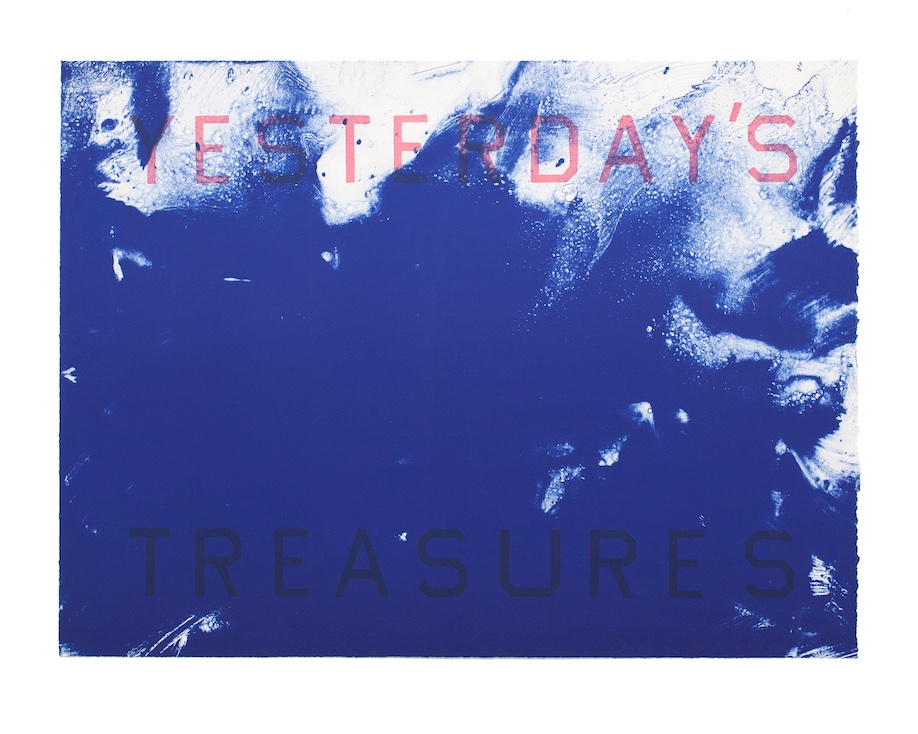
The joint lithograph “Yesterday’s Treasures” (1989), which gives the exhibition its title, unmistakably combines Goode’s abstract cloudscape in milky white and deep blue with Ruscha’s ironic-nostalgic commentary. This finely pointed collaboration contains the tensions of the manifold references and heterogeneous areas of experience from and in which the art of Joe Goode and Ed Ruscha lives.
The exhibition was on view in the rooms of Galerie Thomas Zander and in the adjoining Forum für Fotografie. A catalogue was published by Verlag der Buchhandlung Walther König.