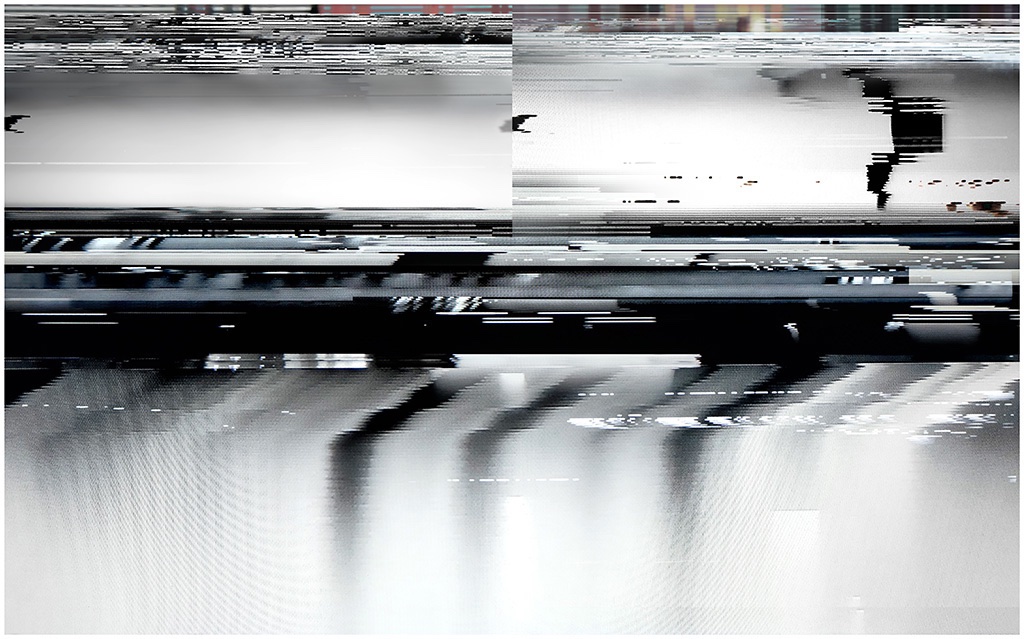
The title of Harald Fuchs’s most recent work, “Villa M/Rom”, is a chimera, for the pictures shown can be assigned neither to a geographical nor to an architectural location. The initial idea that the works might show images of Rome or the Villa Massimo quickly evaporates and is displaced by a persistent, fruitless search for fragments of images already seen and known, and for familiar pictorial structures.
In purely technical terms, the works are a reworking of digital storage media that have been destroyed by ageing. In the original visual messages lost through superimposition, deletion and fragmentation, the artist finds material characteristic of our time with which to continue his cycle of works on the transience of time-based image programmes – a theme that dominates his oeuvre.
With his artistic work, Harald Fuchs demonstrates that perception, visual information and semantic structure are subject to a highly complex process which, in an almost limitless variety of biological, cultural and technical variants, produces images that feed doubts as to whether the relationship between image and reality can still be interpreted as congruent, or at least as corresponding to reality.
However, one quickly recognises a way of dating the images’ creation. Unmistakably, there are digital pictorial structures such as pixels, colour bands, chromatograms, and recordings of electron oscillations and magnetic interactions. All these pictorial elements have only become possible through the digital imaging techniques of our time, in which the boundaries between the atomic dimension, the microcosm and the energy discharges of the universe are dissolving scientifically – techniques that were unimaginable only a few decades ago.
For his new cycle of works, Harald Fuchs preferred to choose pictorial building blocks from the visualisation of electron oscillations on destroyed magnetic recording tapes and assembled them into novel images which, only on the basis of our determined processes of perception, call to mind in the viewer familiar terms such as beauty and visual aesthetics.
With the exhibition “Harald Fuchs – Villa M/Rom”, the Forum für Fotografie Köln aims to contribute to the discussion about the artistic expansion of the medium of photography. In view of advancing knowledge about atomic and viral microstructures, epistemological changes are increasingly revealing their great influence on a variety of hitherto unknown physical and social processes. These themes will continue to gain importance in artistic engagement in the future.