The visible and the indeterminate
What do we see when we look at a photograph?
At first the question seems simple. We see real places, a real street, people. We recognise New York or another metropolis, a movement, a gesture, perhaps an encounter. And yet the photographs of Saša Fuis begin to become interesting precisely where this supposed certainty ends.
For what happens in these pictures can rarely be named unambiguously.
Invisible Moments – the title of the exhibition denotes a paradox. Photography makes visible. It records what was in front of the camera at a particular moment. And yet there seems to be something in Saša Fuis’s photographs that eludes precisely this visibility. What matters lies not only in what we can recognise, but just as much in what we do not understand.
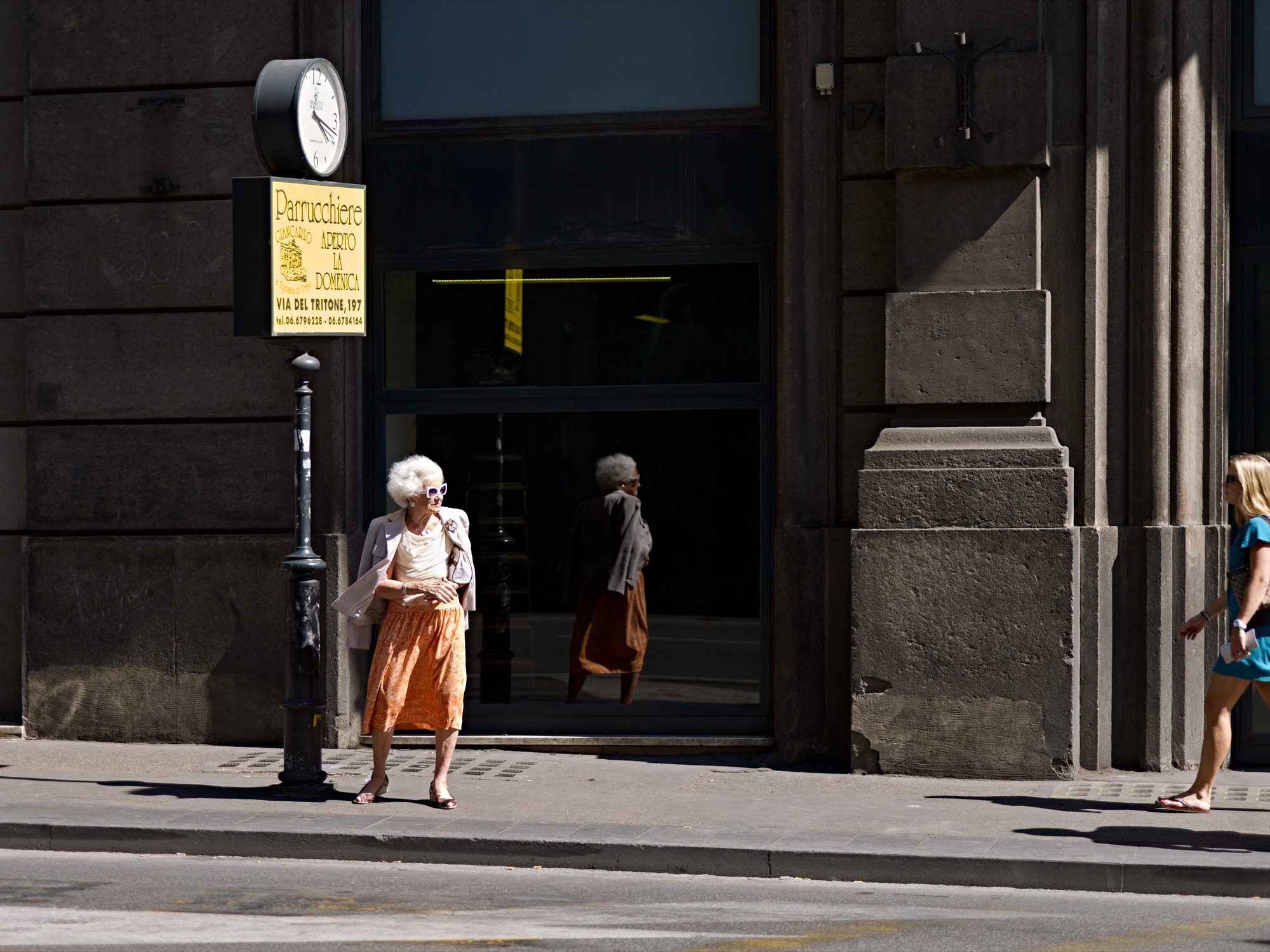
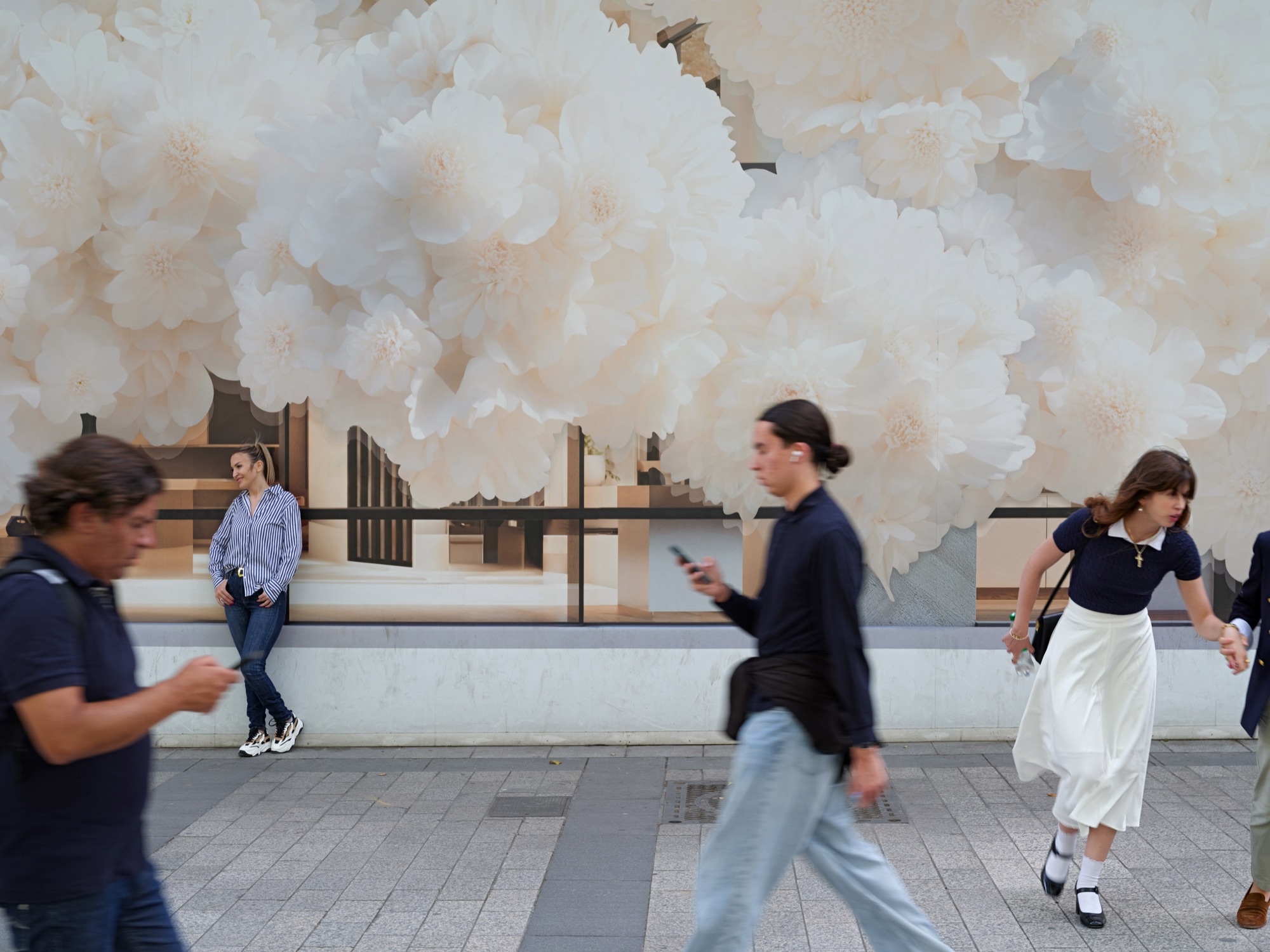
People appear at crossroads, in front of façades or behind panes of glass. Their gestures seem to point to something whose cause we do not know. Gazes lead out of the picture. Bodies enter into peculiar relationships with the architecture. Closeness and distance arise for a fraction of a second and dissolve again immediately afterwards.
Something is happening. But what is happening? The question remains open.
It is precisely in this that Saša Fuis’s photographs differ from a primarily documentary understanding of street photography. For him, the street is less an object of social description than a space of visual possibilities. His pictures do not seek to explain how a city works. They pursue neither reportage nor anecdote, neither the spectacular event nor that punchline which condenses a chance street scene into a small, self-contained story.
Reality supplies the material for Saša Fuis’s pictures. But it is not necessarily their subject.
From the decisive to the invisible moment
Hardly any concept has shaped the history of street photography more strongly than Henri Cartier-Bresson’s idea of the decisive moment.¹ His photographic stance rests on the conviction that, for a fraction of a second, the meaning of an event and the formal organisation of the perceived elements can condense into a unity. Form and event cannot be separated.
Saša Fuis’s photographs are close to this tradition and at the same time depart from it in a remarkable way.
Fuis, too, responds to fleeting constellations. His pictures, too, arise from a precise perception of space, body, light and time. But his interest begins precisely where the world does not arrange itself into clarity for the camera.
What seems to fascinate him is the moment in which clarity is lost.
In Fuis’s case, the decisive moment might therefore be set against the invisible moment.
It is not the climax of an event. Perhaps it is not even an event. It is rather the moment in which the ordinary shifts into the enigmatic.
An everyday situation suddenly becomes strange. A movement appears disconcerting. Two people who may have nothing to do with each other seem related to one another in the picture. An architectural form acquires a new meaning through the presence of a body.
The decisive moment condenses meaning. The invisible moment calls it into question.
This juxtaposition does not claim to establish a new art-historical category. Rather, invisible moment denotes a specific pictorial strategy of Fuis’s: whereas Cartier-Bresson’s model aims at the condensation of event and form, in Fuis’s work the meaning of the observed constellation deliberately remains suspended.
The city and the uncanny in the everyday
This becomes particularly clear in Fuis’s pictures of international metropolises, not least in his photographs from New York.
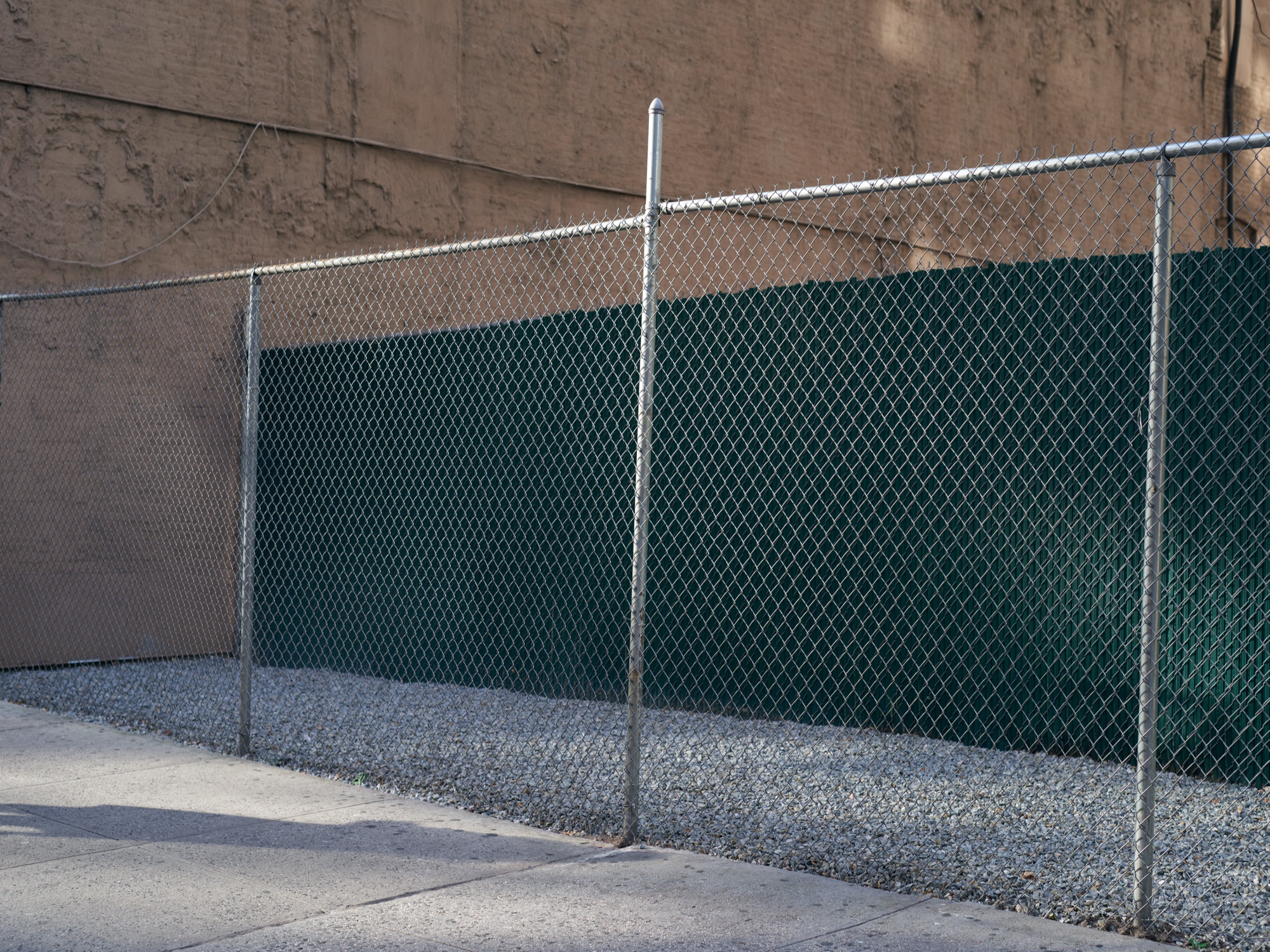
Here the city does not appear as the sum of its sights. It is neither celebrated nor systematically described. Rather, it forms an unstable structure of architecture, light, reflections, signs and people.
In the process, the familiar can suddenly become strange.
And in this there is at times something uncanny.
In his 1919 essay The Uncanny, Sigmund Freud explained the concept of the uncanny in terms of the ambivalence of the homely, the known and the familiar.² This concept is not to be applied to Saša Fuis’s photographs in the sense of a psychoanalytic interpretation. Rather, it can serve to describe an aesthetic experience. The familiar remains visible, and yet through Fuis’s photographic observation we experience an unsettling of how we look at streets, people, houses, windows and shadows. In a way that is hard to pin down, things seem to have moved away from their familiar reality. A street scene remains a street scene and at the same time seems to mean something else.
But what? Fuis does not answer this question.
His pictures offer no resolution. We do not learn what happened immediately before. Nor do we know what will happen a few seconds later. Photography isolates a moment from its temporal context and thereby withdraws from it precisely the information that could explain it unambiguously.
Susan Sontag drew attention early on to the peculiar power of photographic selection. To photograph always also means to select and to interpret. Photographs are details, fragments of a world that is appropriated and at the same time reordered through the act of photographing. Even where photography feels committed to rendering the real, viewpoint, selection and aesthetic decision remain at work.³
In Fuis’s work this fundamental structure of photography becomes aesthetically productive. Reality, place and time are fragmented by the photograph. The fragmentary is not a deficit that would need to be supplemented by a caption or a narrative; it is part of the picture.
The apparent reality of cities thus becomes a space of the possible. The accidental can appear meaningful, the incidental central, the ordinary strange. Urban reality appears not as a controllable order but as an unpredictable web of situations whose connection remains enigmatic.
Reality becomes a picture
In Camera Lucida, Roland Barthes drew a remarkable connection between photography and theatre. For him, photography approaches the tableau vivant, the scene brought to a standstill and turned into appearance; in this context he speaks of a kind of “primitive theatre”.⁴
For Saša Fuis, the notion of staging is relevant only with regard to the transformation of meaning associated with it. The situations Fuis photographs are found. People are not turned into actors in a plot arranged for the camera. The scenes photographed are not staged. They belong to the continuous flow of events in urban space. The photographer faces these events as an observer.
But at the moment the photograph is taken, something decisive happens: a passing situation becomes a picture.
What existed side by side in real urban space for a fraction of a second is lifted out of the temporal continuum by the photographic frame. People and things enter into relationships that may already have vanished the next moment.
The photographer does not stage these relationships. But he recognises them. And by recognising them, he makes them visible.
In this context, the title of an earlier exhibition by Saša Fuis, Unstaged, can also be understood as a precise description of an essential aspect of his photographic stance: Fuis looks for his pictures in found reality. He does not arrange events for the camera but responds to situations that arise independently of his photographic intention.
The title of our exhibition, Invisible Moments, points to another aspect.
It describes less the way the photographs come into being than the particular quality of those moments that Fuis perceives within everyday events. The title of the earlier exhibition, Unstaged, describes a position towards what is found; Invisible Moments directs our gaze to what, within this found reality, briefly gives rise to uncertainty.
Both terms mark different but interconnected aspects of the same photographic stance. One denotes the reality the photographer encounters. The other concerns the gaze with which he encounters it.
Sontag pointed out that even a photograph that consistently focuses on what is found is necessarily shaped by selection, viewpoint and aesthetic decision.³
Peter Geimer has taken these reflections further for more recent photographic theory. The history of photography has been shaped by ideas of the imprint, the trace and the index – that is, by the particular relationship of the photographic image to something that actually existed in front of the camera. At the same time, photographic meaning never arises from this relationship to the real alone. It develops just as much from selection, contextualisation and the specific organisation of the visible.⁵
Precisely in this lies a productive tension: the photograph remains connected to reality without being identical with it.
For Fuis this connection is central. His pictures need found reality. Without it they could not come into being. But their artistic substance begins where, within this reality, a constellation becomes visible that perhaps no one had previously perceived as such.
At this point Barthes’s famous definition of photography as ça-a-été, as “that-has-been”, takes on particular significance. Barthes calls this ça-a-été the noeme of photography: what appears in the photographic image must have been present in front of the lens at a particular moment.⁶
This certainty is fundamental. But it has a limit. The certainty concerns the existence of what has been. Not its meaning.
And it is precisely in this gap – between the certainty of having been there and the indefinability of what this having-been-there might mean – that many of Saša Fuis’s photographs move.
Distance as an aesthetic stance
Saša Fuis himself describes his photographic position in comparison with established positions with remarkable precision. In Stephen Shore and Joel Sternfeld he values the calm, observational way of working. Joel Meyerowitz and Garry Winogrand, by contrast, stand for him for a more dynamic form of street photography – often with wide-angle lenses, physical closeness and a correspondingly animated organisation of pictorial space. With Meyerowitz, construction through colour also comes clearly to the fore. Fuis’s own stance is a different one.
He mostly works with standard or slightly telephoto lenses. He keeps his distance. The camera does not push its way into the event. This technical decision is at the same time an aesthetic one.
Distance here does not mean indifference. Rather, it means leaving things their independence.
The photographer observes without intervening in the situation. People do not become performers in a story he has devised. They retain something inaccessible.
We see them. But we do not know them.
We see their gestures. But we do not know what they mean.
We see a situation. But we do not possess its story.
This restraint distinguishes Fuis from the kind of street photography whose quality arises essentially from immediate physical presence, surprise and visual collision.
His pictures are quieter – and precisely for that reason they can unsettle us lastingly.
The trained eye
Part of this stance is a biographical particularity that is by no means incidental to an understanding of Saša Fuis’s independent work.
For decades Fuis has professionally photographed works of art for major auction houses, museums and private collections. Painting, sculpture, decorative art objects and, not least, works of historical, modern and contemporary photography are part of his everyday professional life.
At first this work seems to demand something different from his independent photography: utmost accuracy. The work of art is to be captured as precisely as possible in its materiality, its colour, its surface and its proportions. The photographer’s personality is precisely not supposed to step demonstratively between the work and its reproduction. Rather, the quality of his work proves itself in helping the photographed work of art to the greatest possible presence without putting himself in the foreground.
Yet this very restraint is at the same time an exceptional school of seeing.
Anyone who has spent decades looking at works of art, lighting them, analysing them photographically and translating them into a two-dimensional representation is constantly engaged with form and surface, colour and materiality, light and shadow, proportion and pictorial space.
What emerges is not only a particular familiarity with the technical demands of art photography, but also with the diversity of artistic visual languages.
Anyone who repeatedly encounters historical, modern and contemporary art conducts – consciously or unconsciously – an ongoing visual dialogue with the history and present of the image.
No simple history of influence should be constructed from this. Saša Fuis’s independent artistic photography cannot be derived directly from his professional work with works of art. But this decades-long direct proximity to art forms a space of visual experience that accompanies his gaze.
Against this background, perhaps a remarkable tension in his photographs can also be understood: the combination of utmost formal assurance and openness of content.
In the professional photography of works of art, Fuis must see exactly what is in front of him.
In his independent artistic photography, by contrast, he is interested precisely in what eludes unambiguous seeing.
The one demands precision of reproduction. The other, precision of perception. It is precisely here that the two activities touch.
Precision and indeterminacy
This gives rise to a paradox characteristic of Fuis’s work.
His photographs are technically and formally extraordinarily precise. Nothing about them is casual in the sense of photographic carelessness. Framing, spatial layering, focus, colour and light are controlled. Yet this precision does not lead to a corresponding clarity of meaning.
On the contrary: the more precise the picture, the more enigmatic what it shows can become. The vagueness of these pictures is not a lack of information but an aesthetic strategy.
The photo historian Bernd Stiegler has shown how strongly our understanding of photography is shaped by metaphorical figures of thought: the camera as eye, the photograph as trace of the past or as witness to a reality.⁷ Each of these metaphors formulates a particular expectation of the medium of photography.
Fuis’s works seem to play with several of these expectations.
They have the credibility of testimony but refuse its explanation. They are the trace of a real situation without revealing its story. They open a window onto the world – and at the same time make clear that through this window we only ever see a section.
Invisible Moments
And so, finally, the title of our exhibition also takes on its fuller meaning.
The Invisible Moments are not moments that no one could see. They are constellations which, at the moment of their coming together, do not immediately impose an interpretation on the viewer.
Perhaps it is precisely in this lack of clarity that the particular strength of these works lies.
They show us a reality that lies fully visible before us and yet does not become entirely legible. Perhaps Invisible Moments therefore denotes less what Saša Fuis photographs than the particular experience his photographs make possible for us:
The brief moment in which we see something without yet understanding it.