

The winners of the young talent programme “gute aussichten – junge deutsche fotografie 2007/2008” have been chosen. The jury – the initiator Josefine Raab (Wiesbaden), the head of the DZ Bank art collection Luminita Sabau (Frankfurt am Main), the artist and photographer Thomas Demand (Berlin), the art director Mario Lombardo (Cologne) and the curator of the Haus der Photographie, Deichtorhallen, Ingo Taubhorn (Hamburg) – selected 11 photographers with ten works (one a joint work) from 83 works submitted by German universities and art schools:
Two people in a room, various props and the intention of making a picture every day: Catrin Altenbrandt and Adrian Nießler, who have been realising joint projects for some time, were the test subjects of their own experiment for their work “Um was es nicht geht”. The result is a colourful mix of photography, typography and installation in which creative playfulness and spontaneous inspiration combine in the best way with a pronounced will to form.
In her series “innerwald”, Annette Grotkamp enters spaces of artificial or cultivated nature, dissolving the clear boundaries between inside and outside, between real and created landscape, in favour of poetic, nature-like compositions in which the viewer seems to float without reference to time and space.
For his “Nachtrecorder”, Jon Adrie Hoekstra first worked as a night reporter, recording in words and pictures what happened on a main road in Münster, Westphalia, between midnight and six in the morning over a certain period. The recordings were presented to the residents as an exhibition and published as a newspaper, bringing what had happened back into the community.
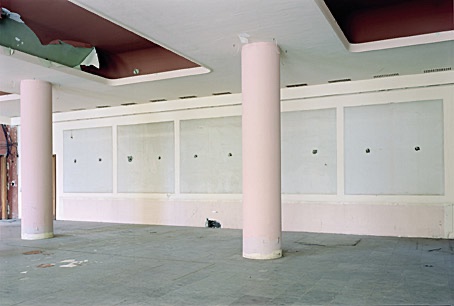
In “Die verschwundenen Bilder”, Margret Hoppe deals with works of art in the former GDR and with what happened and is still happening to this cultural legacy after the fall of the Wall.
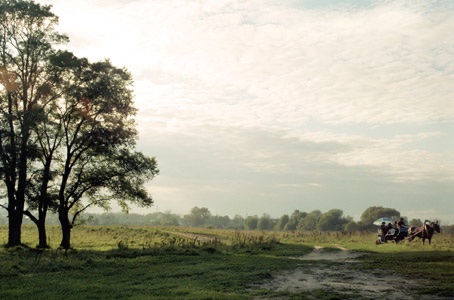
In “An Deinem Haus”, Andrej Krementschouk traces his old homeland, a Russian village threatened with disappearance, in melancholy pictures, raising the ever-topical question of memory and loss, of emotional roots and cultural identity.
In “Portraits #1–#5”, Belaid le Mharchi attempts to find a pictorial translation for the horror left by the atomic bombing of Hiroshima and Nagasaki, both among those affected and in the world.
In “kosmos”, Agata Madejska explores the world of playgrounds, creating magical places and images that transport the viewer into a long-forgotten world of childhood dreams.
In “Gretchen”, Caterina Micksch captures with an almost laconic gaze places where murdered infants were found in 2006. As in Belaid le Mharchi’s portraits, the documentary objectivity of the pictures produces horror only in connection with knowledge of what happened.
In “Vater Land und Mutter Erde”, Jörg Obernolte undertakes a 778-kilometre journey along federal highway 1 from west to east, which he documents and comments on in a photographic travel diary.
In “Refugium”, Christian Tiefensee sets out on a journey inward – into the psychological structure which, as an open, flexible and ambivalent structure, forms the basis of human existence.
As in the first three years, “gute aussichten” offers a unique and often surprising overview of what has been produced in young photography in Germany over the last 12 months. The initiator Josefine Raab on this year’s selection: “There are recognisable trends, but no single direction. Each ‘gute aussichten’ year reflects more or less strong currents and stylistic elements. In the last two years we have increasingly observed photography crossing over into other media such as film, theatre and performance, media-critical engagement, staging and self-questioning, spatial and landscape photography. In the year of documenta 12, social, cultural and societal questions are appearing more strongly for the first time in young German photography, which is clearly reflected in this year’s selection.”